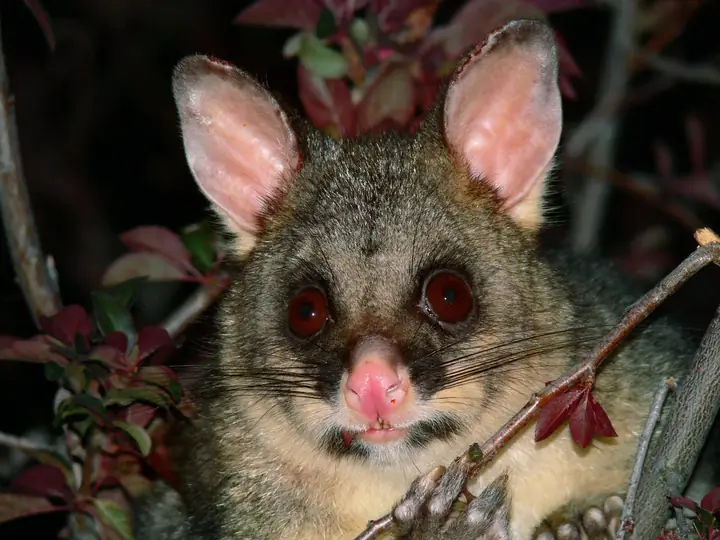
Short answer
Possums are protected native animals. Confirm it's a possum (cat-sized, heavy thumps at night), put a nest box in a nearby tree, then block the entry only after it has gone out to feed at night. Trapping needs a licence or permit in NSW, Queensland and SA. In Victoria a householder may cage-trap a brushtail in the building, but must release it on the property, within 50 m, after sunset.
Covers New South Wales, Victoria, Queensland and South Australia.
- Legal status
- Protected native animal[1]
- Trap it yourself?
- Only in Victoria (brushtails in buildings)[2]
- When to seal the gap
- At night, around 8–10 pm[3]
- Nest box height
- At least 4 m up a tree[1]
On this page
Possums in the roof are one of the most common wildlife problems in Australian homes. The fix is usually the same everywhere: give the possum somewhere else to live, then close the way in while it’s out. Trapping is a last resort and the rules differ a lot between states.
First: confirm what it is
Rats and mice cause the same kind of disturbance, and the rules for possums don’t apply to them. South Australia’s environment department lists heavy bangs on the ceiling at night, stains or a strong ammonia smell from urine, and chewing or scratching damage as the typical possum signs.[4] Rats and mice tend to make gnawing, scuffling and squeaking sounds and leave droppings and greasy marks along the paths they travel.[6]
Brushtail, ringtail or rat?
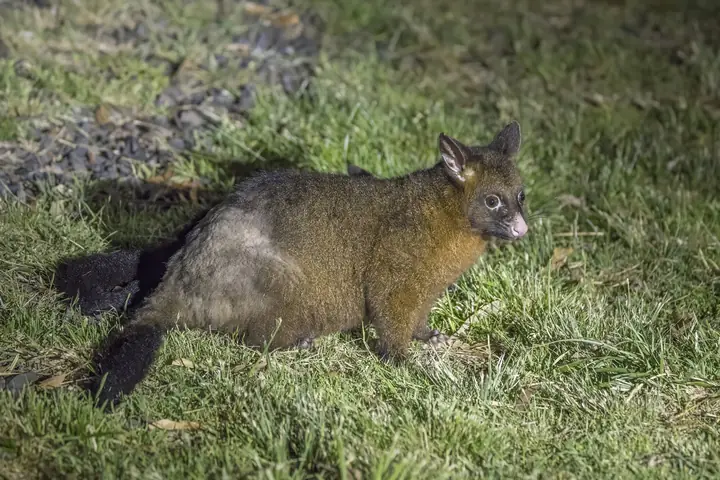
Common brushtail possum
Trichosurus vulpecula
- About the size of a cat
- Large pointed ears
- Bushy black tail
- The possum most often found in roofs
Source [2]
 Photo to come
Common ringtail possum
Pseudocheirus peregrinus
- About half the size of a cat
- Round ears
- Curled tail with a white tip
- Rarely lives in house roofs
Source [2]
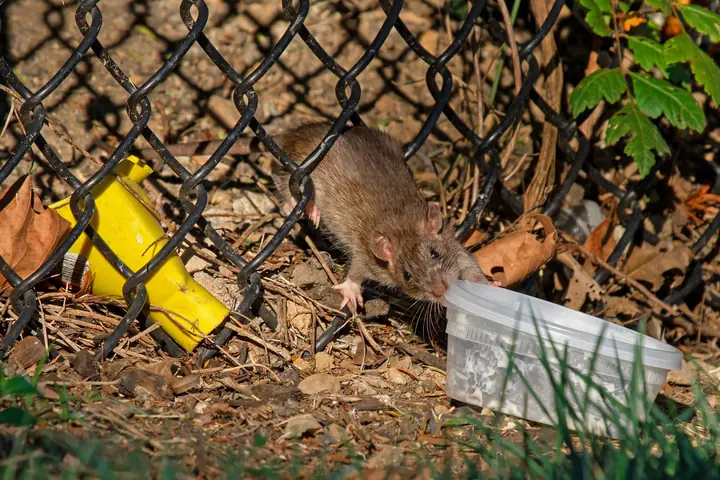
Rats and mice
Rattus spp. (brown rat shown)
- Much smaller than a cat
- Gnawing, scuffling and squeaking
- Droppings and greasy marks along runs
Source [6]
Quick check: possum or rats in the roof?
Answer what you can. The result only points you to the next step — the dusk watch and the flour test below are what confirm it.
| Sign | Possum | Rats or mice |
|---|---|---|
| Noise | Heavy bangs at night | Gnawing, scuffling, squeaking |
| Size seen at dusk | About the size of a cat (brushtail) | Much smaller than a cat |
| Other signs | Ceiling stains, ammonia smell, scratching damage | Droppings, gnaw damage, greasy marks along runs |
Two checks settle it:
- Watch at dusk. Stand outside near the gap you suspect and watch as it gets dark. A common brushtail possum is about the size of a cat, with pointed ears and a bushy black tail.[2]
- Do the flour test. Sprinkle flour near the entry point overnight and look at the footprints the next morning.[1]
A small possum with a white-tipped curled tail is a ringtail. Victoria notes that ringtails rarely live in house roofs, and trapping one there needs a permit.[2]
Get it out without trapping
This approach works in every state, because you never catch the animal.[1, 5]
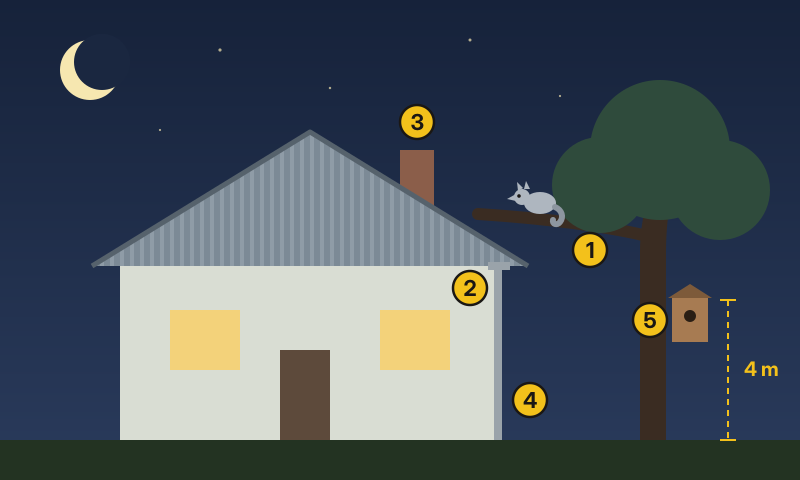
- 1Branches touching the roof. Trim them back; Victoria suggests a gap of at least 1.5 m.
- 2Gaps at the eaves and roof edge. Block them at night, after the possum has gone out.
- 3Chimneys. Check the top and any gaps where it meets the roof.
- 4Downpipes. NSW lists drainpipes among the ways in to check.
- 5A nest box at least 4 m up a garden tree gives it somewhere else to live.
- Offer a new home first. Put a possum nest box in a tree in your garden. NSW recommends mounting it at least 4 m above the ground. Moving the possum’s nest material from the roof into the box, and leaving fresh fruit nearby, encourages it to move in.[1, 5]
- Make the roof less appealing. Sprinkle quassia chips (sold at hardware stores) in the roof cavity and leave a light on there for three days and nights.[1]
- Find every way in. Check the roof edges, chimneys and downpipes. Trim branches that reach the roof — Victoria suggests leaving a gap of at least 1.5 m.[1, 2]
- Seal up at night, after it has left. Watch it go out to feed, then block the gap with wire mesh or timber, or fit a one-way flap that lets it out but not back in. Queensland suggests doing this around 8–10 pm.[1, 3]
- If it comes back, there is another way in. Find it and repeat the steps.[1]
Trapping and release rules by state
If the steps above don’t work, the rules in your state decide what comes next. Most people end up calling a licensed operator.
| State | Trapping or removal | Release |
|---|---|---|
| NSW | Catching and releasing a possum without a licence is illegal. Hire a licensed catch-and-release operator, or apply for a landholder's licence once other options are exhausted. | At dusk, no more than 150 m from where it was caught, next to something it can climb. [1] |
| VIC | Householders, building managers and licensed wildlife controllers may cage-trap a common brushtail living in a building. Trapping a ringtail needs a permit. | On the same property, no more than 50 m from the capture site, after sunset on the day of capture. Relocating a brushtail is prohibited. [2] |
| QLD | Trapping possums is illegal without a permit. Use a qualified possum removalist. | The source does not set a distance — ask the licensed operator how they will release it. [3] |
| SA | You need a Trap and Release Protected Wildlife permit, and may only trap inside the roof space or another built structure. | No more than 50 m from your home. [4] |
Victoria also sets trap standards: a cage trap that can’t injure the possum, ideally wire mesh smaller than 19 mm, placed level and sheltered from pets, wind, rain and sun. Check it within two hours of sunrise, and keep a trapped possum covered in a quiet place until you release it after dark.[2]
For Western Australia, Tasmania, the ACT and the Northern Territory, check your state or territory wildlife agency before trapping. The RSPCA notes that some states and territories require a licence or permit.[5]
Mistakes that make it worse
- Moving it a long way away. Released possums often don’t survive in unfamiliar territory, because other possums already hold it.[1]
- Sealing up during the day. The possum is still inside. Wait until it has gone out to feed.[4]
- Handling it. Queensland’s advice is never to touch native wildlife.[3] An injured possum should go to a local wildlife rescue group.
If it turns out to be rats
Seal holes and gaps, keep food in the fridge or sealed containers, pick up fallen fruit and store pet food securely. If that doesn’t contain the problem, call a licensed pest control company.[6]
Who to call
- NSW: a licensed possum catch-and-release operator. NSW suggests asking them to confirm their licence.[1]
- Victoria: a licensed wildlife controller if you don’t want to trap yourself.[2]
- Queensland: a qualified possum removalist.[3]
- South Australia: a licensed possum pest controller.[4]
- Injured or orphaned possum: your local wildlife rescue or rehabilitation group.[1]
Common questions
Can I just move the possum to a park or bushland?
No. Relocating possums is illegal in NSW and prohibited for brushtails in Victoria, and NSW notes that moved possums often don't survive because the best territory is already taken.
Can I trap a possum myself?
Of the four states covered here, only Victoria lets a householder trap without a permit — and only a brushtail living in a building, with a suitable cage trap and same-day release within 50 m. NSW needs a licence, and Queensland and South Australia need a permit.
When is the right time to block the hole?
At night, after you have seen the possum leave to feed. Queensland suggests doing the work around 8–10 pm. Check first that no young are left inside.
How do I know it isn't rats?
Possums make heavy bangs and are about the size of a cat. Rats and mice make lighter gnawing and scuffling noises and leave small droppings and greasy marks. Watching at dusk or checking footprints in flour settles it.
Sources
- How to remove a possum from your roof, NSW Department of Climate Change, Energy, the Environment and Water. Read 3 November 2026.
- Possums, Victorian Government, wildlife.vic.gov.au. Read 3 November 2026.
- How to remove a possum or snake from your house, Queensland Department of the Environment, Tourism, Science and Innovation. Read 3 November 2026.
- What to do if there's a possum in your roof, South Australian Department for Environment and Water (Published 2017). Read 3 November 2026.
- How can I live happily with the possums on my property?, RSPCA Australia Knowledgebase. Read 3 November 2026.
- Rats & mice, Cairns Regional Council. Read 3 November 2026.